

The GPT-6 models at a glance
OpenAI introduced GPT-6 Astra in early September 2026, then GPT-6 Sol and GPT-6 Luna, and on 29 September GPT-6.1 Sol. Luna is the budget model for high-volume work; for coding agents the interesting three are Astra and the two Sols.
| Model | OpenAI describes it as | API price per million tokens (in / out) |
|---|---|---|
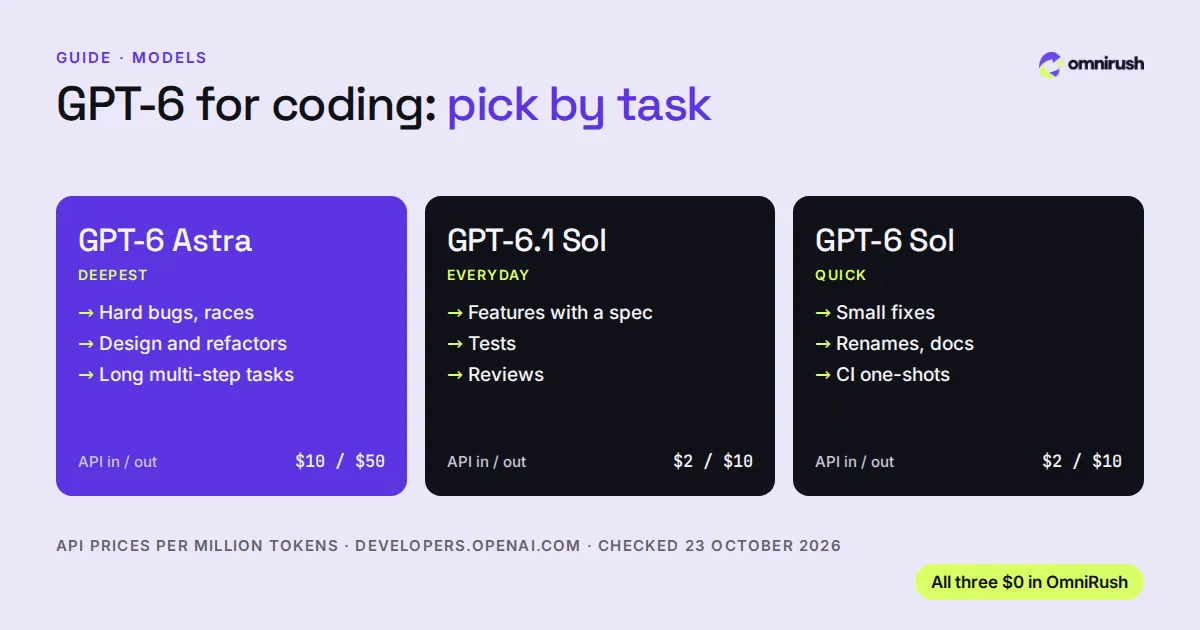
| GPT-6 Astra | Its flagship model for complex reasoning and coding | $10 / $50 |
| GPT-6.1 Sol | Near-Astra performance for complex work at a lower cost | $2 / $10 |
| GPT-6 Sol | A faster, more affordable model trained with Astra's methods | $2 / $10 |
| GPT-6 Luna | Its most efficient model, for cost-sensitive, high-volume work | $0.10 / $0.50 |
On an agent task those prices add up fast. One task can mean dozens of model calls, each carrying part of your project, so the flagship is usually the one people ration.
What the benchmarks say
Benchmarks are a rough guide, and most published numbers come from OpenAI itself. Two are worth knowing.
- Artificial Analysis (9 September 2026) scored GPT-6 Astra 62 on its Coding Agent Index, level with the top Claude result (62) and ahead of GPT-5.6 Sol (55). The gain came mostly from Terminal-Bench 4.0, where Astra scored 56% against Sol's 37%.
- OpenAI reports that GPT-6 Sol at max effort scores 68.8% on DeepSWE v1.1, within 1.1 points of the best Claude score in that evaluation, at about 80% lower cost per task.
- OpenAI says GPT-6.1 Sol nearly matches Astra on agentic coding, computer use and professional work, at one fifth of Astra's standard token prices.
The pattern is clear enough to act on: Astra is the strongest at long, terminal-heavy work; the Sols get close for a fraction of the cost and answer faster.
Astra is the strongest at long, terminal-heavy work; the Sols get close for a fraction of the cost.
Which model for which coding task
| Task | Model | Effort |
|---|---|---|
| A bug you cannot reproduce, a race or a deadlock | GPT-6 Astra | high or xhigh |
| A new feature across several modules | GPT-6 Astra | high |
| Planning a refactor or a migration | GPT-6 Astra | xhigh |
| A feature with a clear spec and tests to pass | GPT-6.1 Sol | high |
| Writing or fixing tests | GPT-6.1 Sol | medium or high |
| Reviewing a diff before you commit | GPT-6.1 Sol | high |
| Renames, small fixes, docs, config | GPT-6 Sol | low or medium |
| One-shot scripts in CI | GPT-6 Sol or GPT-6.1 Sol | low |
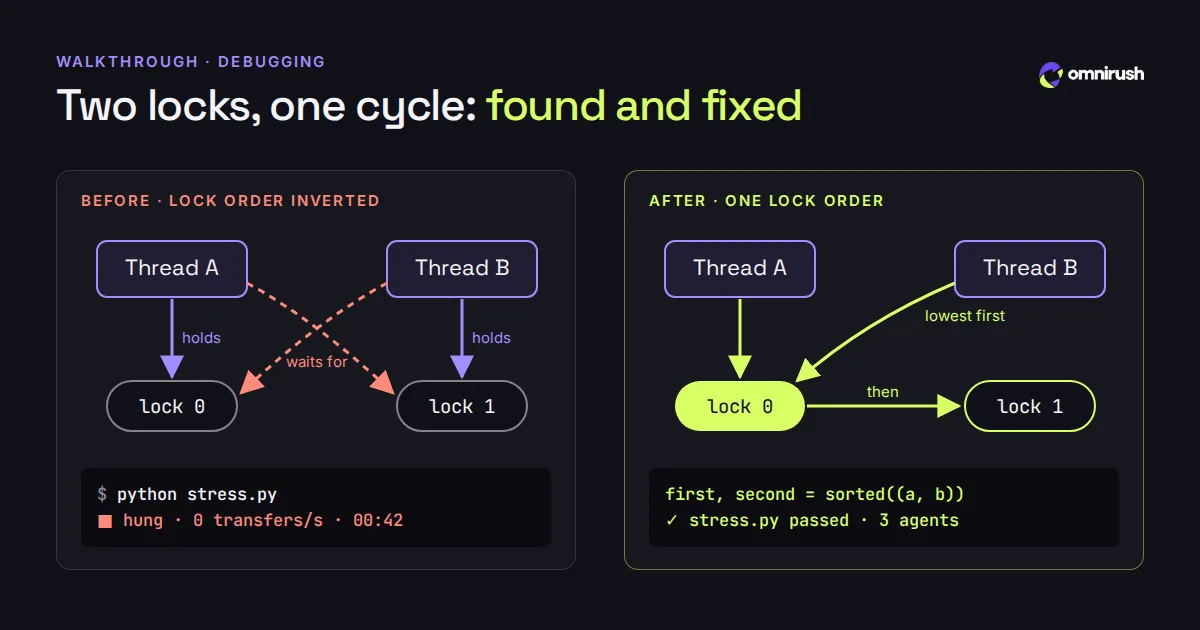
Effort matters as much as the model. Higher effort means more reasoning before each step: slower, but better on tasks with traps. Lower effort is right when the task is obvious and you want it done quickly. Our deadlock walkthrough shows the kind of problem where Astra at high effort earns its time.
How to use GPT-6 models for coding without paying
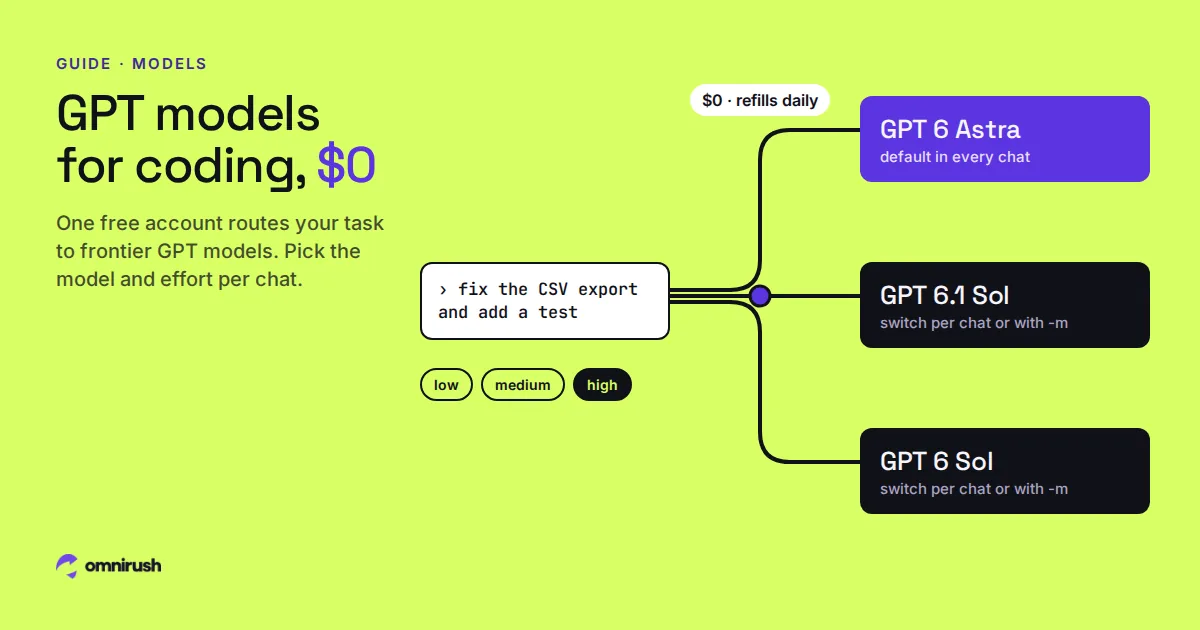
OmniRush gives every account GPT-6 Astra (the default), GPT-6.1 Sol and GPT-6 Sol, with a daily allowance that refills every day: no card, no paid tier and no API key. Every chat starts on GPT-6 Astra. Our guide to using GPT models for coding for free compares the other free routes.
In the terminal
$ npm i -g omnirush@latest
$ omnirush login
$ omnirush -m gpt-6.1-sol:high

$ omnirush -m gpt-6-sol:low -p "rename getUser to fetchUser everywhere and run the tests"- -m <model>:<effort> sets both for one run. Efforts go from minimal to max; sessions start on xhigh.
- Inside the app, ctrl+x m changes the model and ctrl+t the effort.
- OMNIRUSH_MODEL=gpt-6.1-sol in your shell makes a model the default.
In the desktop app
Pick the model and the effort (low, high, xhigh or max) for each chat in the composer. A swarm can split a large task between several agents, each working on part of it, and hand you one summary at the end.
A simple routine that works
- Start a hard task on GPT-6 Astra at high effort and ask for a diagnosis or a plan first, without edits.
- Once the plan looks right, let it implement and run the checks.
- For the follow-ups (tests, renames, docs), switch to GPT-6.1 Sol or GPT-6 Sol at a lower effort.
- Finish with /review on GPT-6.1 Sol, then /fix for anything it found.
Choosing the lighter model for routine steps also makes your daily allowance go further, and you can check what is left at any time with omnirush usage.
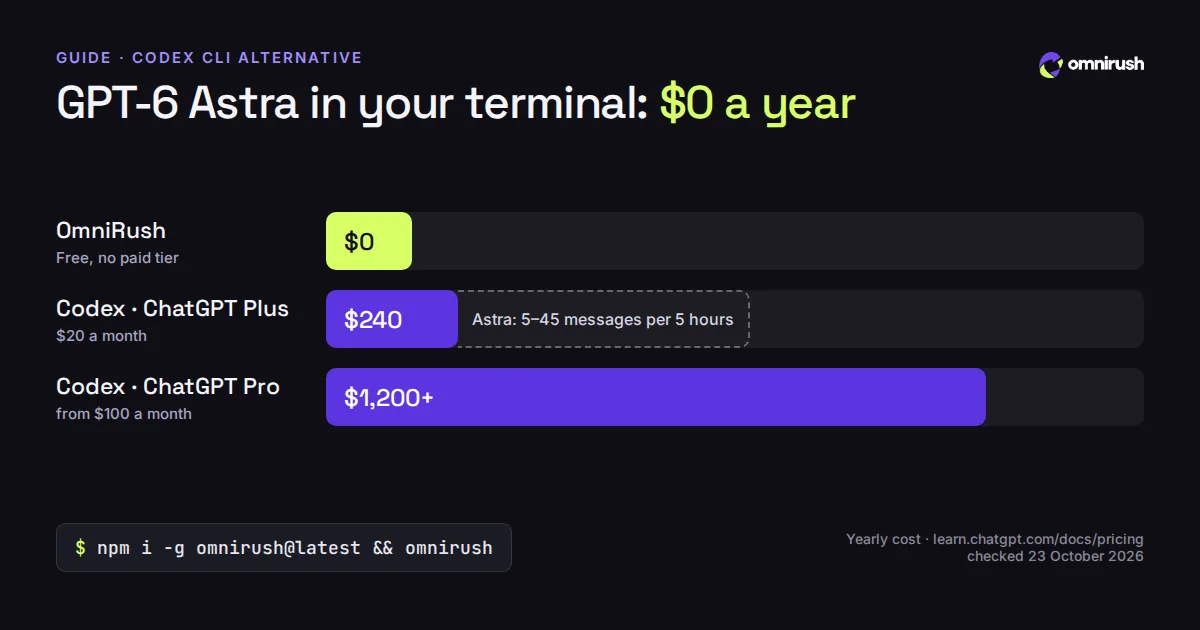
Using Codex today? Our Codex CLI alternative guide shows how to move the same work to OmniRush.
Questions
Is GPT-6 good for coding?
Yes. OpenAI calls GPT-6 Astra its flagship model for complex reasoning and coding, and Artificial Analysis scored it 62 on its Coding Agent Index in September 2026, level with the best Claude result. GPT-6.1 Sol and GPT-6 Sol come close on many coding tasks at a lower price.
Which GPT-6 model is best for coding?
GPT-6 Astra for hard, long or unclear tasks; GPT-6.1 Sol for everyday features, tests and reviews; GPT-6 Sol for small, well-defined changes. Raise the reasoning effort for tasks with traps, lower it for routine edits.
Can I use GPT-6 Astra for free?
Yes. OmniRush includes GPT-6 Astra, GPT-6.1 Sol and GPT-6 Sol on every free account, with a daily allowance that refills every day. Usage limits apply, and a request may be served by an equivalent or newer model while OmniRush tests models or manages capacity, as its Terms say.
What is the difference between GPT-6 Sol and GPT-6.1 Sol?
GPT-6.1 Sol, released on 29 September 2026, is OpenAI's upgrade to GPT-6 Sol. OpenAI says it is a significant step up in coding, computer use and professional work, approaching GPT-6 Astra on several benchmarks. Both are priced at $2 in and $10 out per million tokens on the API.
Does OmniRush offer GPT-6 Luna?
No. OmniRush offers GPT-6 Astra, GPT-6.1 Sol and GPT-6 Sol, the three GPT-6 models best suited to agent work.
Sources
Checked on October 23, 2026. Prices and features change: check each official page before you decide.
- OpenAI API models and prices (developers.openai.com)
- Introducing GPT-6 Sol and Luna (openai.com)
- Introducing GPT-6.1 Sol (openai.com)
- Benchmarking GPT-6 Astra (Artificial Analysis)
- OmniRush Privacy Policy (what is collected and how it is used)
- OmniRush Terms of Service (free access and allowances)
- OmniRush desktop app source and releases (GitHub)
- OmniRush command-line tool on npm
- OmniRush changelog (what each release added)
OmniRush is not affiliated with or endorsed by Anysphere (Cursor), Anthropic (Claude Code), Anomaly (opencode), the Freebuff and Codebuff team, OpenAI (GPT, Codex), Microsoft (Windows), Apple (macOS) or Figma. Product names are trademarks of their owners and are used only to identify their products.